Podcast

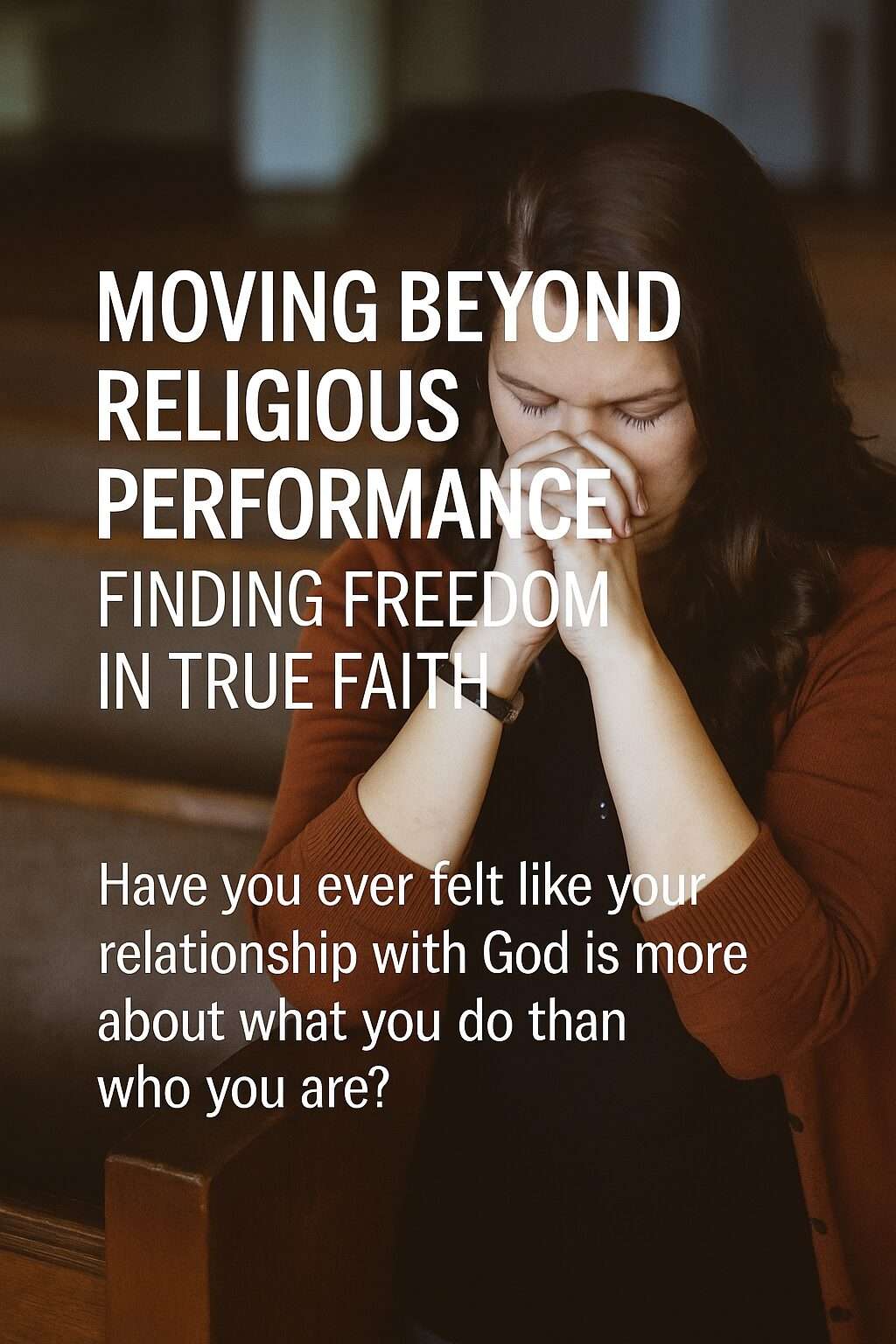
Moving Beyond Religious Performance: Finding Freedom in True Faith

Have you ever felt like your relationship with God is more about what you do than who you are? Like there’s a cosmic scoreboard tracking your prayers, church attendance, and good deeds?

If so, you’re not alone. And you might be trapped in the exhausting cycle of religious performance.

The Hidden Trap Within Faith

Bob found himself standing in the Valley of Religion, surrounded by people who seemed to have all the answers. They were certain. Confident. Convinced.

But as he looked closer, he saw the cracks beneath their serene expressions—glimpses of doubt, fear, and exhaustion. Some wore their devotion like armor, others with the desperate look of people who had staked their entire lives on something they weren’t entirely sure was true.

This is religious performance: the exhausting pursuit of trying to earn what was freely given.

It’s a system as old as time, and it operates by one fundamental rule: do more to be more.

The Two Faces of Religious Performance

Religious performance wears different masks but always leads to the same place—exhaustion, uncertainty, and a hollowness that no amount of activity can fill.

1. The Rule-Keeper

The rule-keeper believes that following the law perfectly will finally earn God’s favor. They meticulously track their spiritual disciplines, feel guilty when they miss a day of Bible reading, and secretly judge others who don’t meet their standards.

Their mantra: “If I do everything right, God will accept me.”

2. The Spiritual Achiever

The spiritual achiever collects spiritual experiences and knowledge like trophies. They attend every conference, read all the latest books, and always have a story about their recent encounter with God.

Their mantra: “If I experience enough, I’ll finally feel whole.”

Both are climbing the same mountain, just on different paths. And both miss the fundamental truth: the climb was never necessary.

The Valley of Religion: A Familiar Trap

“They build temples in the Valley of Religion… and call it the summit.” – Kinsman

Religion, at its worst, becomes about creating structures, systems, and rules that give people the illusion of climbing toward God. It promises security but delivers bondage.

In the Valley of Religion, Bob encountered different voices offering conflicting paths to the summit:

  • “Only 144,000 will make it—the chosen ones, the elect.”
  • “The faithful will be given a new mountain to rule.”
  • “It is through continual penance! The peak is only for those who suffer enough.”
  • “Keeping the law is the only way!”

Each group was certain. Each had a doctrine. Each had a system.

Yet when Bob looked around, the truth was painfully clear: No one had made it.

They had settled for building impressive structures in the valley while calling it the summit.

The Signs You’re Trapped in Religious Performance

How do you know if you’re caught in the cycle of religious performance? Here are the warning signs:

  1. Your relationship with God feels more like a job than a relationship
  2. You feel guilty when you miss spiritual disciplines
  3. You mentally track your “spiritual performance” each day
  4. You compare your faith journey to others
  5. You secretly believe God is disappointed with you most of the time
  6. You’re exhausted from trying to be “good enough”

If these resonate with you, you may have fallen into the trap that has ensnared believers for centuries—trying to earn what has already been freely given.

The Radical Alternative: Living From Inside Out

“Therefore, from now on, I no longer know anyone according to the flesh. I no longer see people from a human point of view. This is a radical and most defining moment.” – Kinsman

The alternative to religious performance isn’t abandoning faith—it’s embracing a different kind of faith altogether. One that flows from the inside out rather than being imposed from the outside in.

Outside-In Living:

  • Follows external rules and expectations
  • Seeks approval through performance
  • Driven by fear of rejection
  • Achieves to earn worth
  • Always climbing, never arriving

Inside-Out Living:

  • Follows internal transformation
  • Rests in existing approval
  • Motivated by love and gratitude
  • Creates from a place of worth
  • Already at the summit, enjoying the view

The Path to Freedom: Letting Go

The path beyond religious performance begins with a simple yet profound act: letting go.

Bob stood at the cross, his heart pounding with realization. He had spent his whole life believing that if he just climbed hard enough, if he just followed the right system, he would make it. And now, he saw the truth. The peak had already been conquered. But not by him. By Him.

With a deep breath, he let the map fall. The wind carried it away. And for the first time in his life, Bob felt something he never had before. Freedom.

Practical Steps to Move Beyond Religious Performance

Moving beyond religious performance isn’t about trying harder in a different direction. It’s about shifting your entire paradigm. Here’s how to begin:

  1. Identify Your Religious Performance Patterns
    • What do you do to feel “right with God”?
    • When do you feel God is disappointed with you?
    • What religious activities do you perform out of obligation rather than love?
  2. Challenge the Voices
    • When you hear “not enough,” ask “Says who?”
    • Question teachings that make God’s love conditional
    • Replace “I should” with “I’m invited to”
  3. Embrace Your True Identity
    • You are already loved, not because of what you do but because of who you are
    • Your worth isn’t earned through performance but received as a gift
    • You are a child of God, not an employee
  4. Practice Being Rather Than Doing
    • Spend time in silence, just being with God
    • Let go of the need to “accomplish” something in your devotional time
    • Rest in God’s presence without agenda
  5. Live From Fullness, Not Emptiness
    • Serve others because you’re full, not to fill yourself up
    • Give out of abundance, not obligation
    • Love because it’s who you are, not to earn points

The Freedom That Awaits

When Bob finally let go of his map—his system of earning, achieving, and performing—he discovered something revolutionary: the peace he had been climbing toward had been available all along.

“Bob… you’re already where you were meant to be. The question is…will you live as though it’s true?” – Kinsman

The invitation is the same for you. Will you continue climbing the mountain of religious performance? Or will you let go of the false maps and discover the freedom that comes from living from the inside out?

The truth is waiting for you, not at the summit of your striving, but in the depths of your being. You were never meant to climb. You were meant to abide.

Bob’s whole body trembled. The old Bob was dead. But the real question was… Who was he now? “What does this mean?” Bob whispered. Kinsman’s eyes shone. “It means everything has changed.”

Everything can change for you too. Not through more effort, but through the radical act of receiving what has already been given.

Want to go deeper? THE CALL workbook is your next step in breaking free from religious performance and discovering your true identity. More than just questions, it’s a guided journey to freedom from the exhausting climb of religious striving. Click herehttps://www.graceempoweredliving.com/call to begin your transformation.
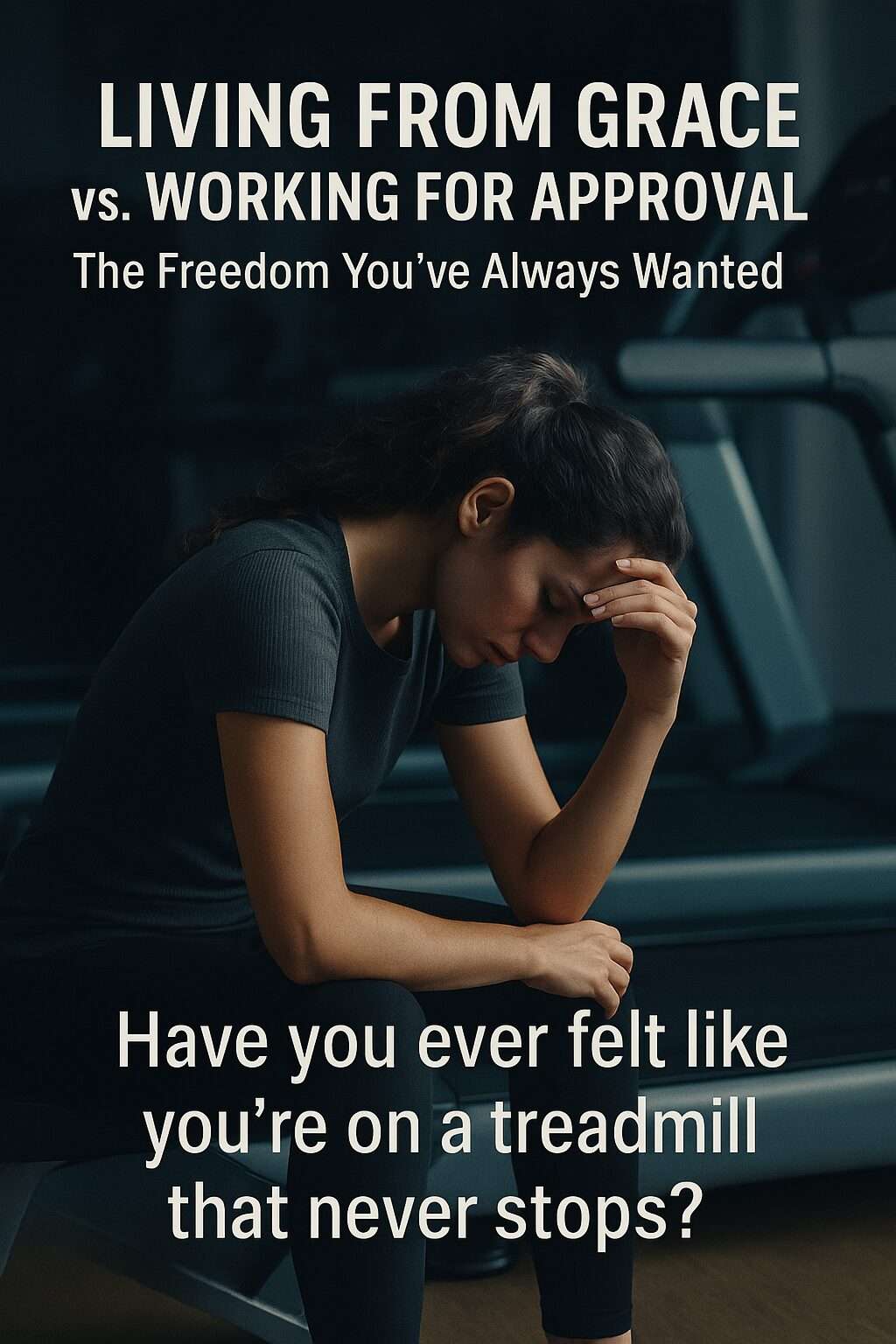
Living From Grace vs. Working For Approval: The Freedom You’ve Always Wanted

Have you ever felt like you’re on a treadmill that never stops? Working harder, achieving more, yet never quite feeling like you’ve arrived? That gnawing sense that no matter what you accomplish, it’s never enough?

You’re not alone. And there’s a reason for this exhausting cycle.

The Invisible Treadmill We Can’t Escape

Bob Cooper thought he had everything figured out. A stable job, a loving family, a comfortable home in a picturesque neighborhood. From the outside, his life looked perfect.

But beneath the surface? He felt like an imposter. A fraud living a carefully curated existence that wasn’t entirely his own. Despite ticking all the boxes society told him would bring fulfillment, something was profoundly missing.

This isn’t just a fictional character’s dilemma—it’s the human condition. We’re all climbing mountains, guided by maps we’ve inherited from family, culture, religion, and society. Maps that promise if we just reach the next level, we’ll finally feel whole.

But what if those maps are wrong?

Two Paths: Working vs. Living

There are fundamentally two ways to approach life:

Path 1: Working For Approval

  • Constant striving to prove your worth
  • Performance-based identity – you are what you achieve
  • Anxiety as your constant companion
  • Comparison as your measuring stick
  • Never enough as your daily mantra

This is the false map. The lie that fulfillment can be found in anything other than Peak Sozo. The lie that material success, power, and even the affection of others can fill the void within.

Path 2: Living From Grace

  • Rest as your foundation
  • Received identity rather than achieved
  • Peace as your companion
  • Freedom from others’ opinions
  • Sufficiency as your starting point

Everything has changed. Security isn’t something to be attained. It’s something you already have. Love isn’t something to be earned. It’s something you already carry. Worth isn’t something to prove. It is something you already are.

The Telltale Signs You’re Still Working For Approval

How do you know which path you’re on? Here are some unmistakable signs you’re still trapped in the approval cycle:

  1. You apologize excessively – even for things that aren’t your fault
  2. You can’t say no without feeling guilty
  3. Criticism devastates you rather than informs you
  4. Your self-worth fluctuates based on your latest performance
  5. You’re exhausted from maintaining your image

Sarah had spent years chasing approval. She didn’t call it that. She called it being responsible. Being a good wife. A good mother. The one who held things together. But deep down, it was more than that. It was fear. Fear that if she didn’t do enough, she wouldn’t be enough.

Sound familiar?

The Root of Our Striving

The moment the first ones stepped off the path of the Creator, shame became their master. It whispered to them that they were not enough. That they had to become something more in order to be whole again. And so, their children—their descendants—began building their lives around that belief.

Most of us don’t even realize we’re striving. We’ve been conditioned since childhood to believe that our worth depends on our performance. This belief is so deeply ingrained that it operates below our conscious awareness.

We learned to cover our shame with achievement, with titles, with wealth. Each success became a fig leaf—a desperate attempt to hide the nakedness we felt inside.

The Freedom of Grace

Kinsman knelt beside him. “You let go.” Bob stared at the map in his hands—the thing that had guided him his whole life. The thing that had whispered in his ear was that he must keep climbing, keep striving, or he would never be enough. With a deep breath, he let it fall. The wind carried it away. And for the first time in his life, Bob felt something he never had before. Freedom.

This freedom isn’t about abandoning responsibility or ceasing to work. It’s about working from a different place—from fullness rather than emptiness.

When you live from grace:

  • You stop trying to earn what’s already been given
  • You cease striving to become what you already are
  • You begin operating from abundance rather than scarcity
  • Your actions flow from love rather than fear
  • Your identity becomes unshakable regardless of circumstance

The Mirror Moment

For the first time, he wondered—what if he stopped? What if he finally let go?

The journey from working for approval to living from grace begins with a mirror moment—when you finally see the exhausting cycle for what it is. When you realize no amount of climbing will ever be enough.

This isn’t about trying harder to be “more graceful.” It’s about recognizing you’ve been climbing the wrong mountain all along.

Practical Steps to Start Living From Grace

  1. Identify your false maps – What beliefs drive your striving?
  2. Challenge the voices – Question the inner critic that says you’re never enough
  3. Practice receiving – Allow yourself to be loved without earning it
  4. Embrace your true identity – You are not what you do
  5. Act from fullness – Make decisions from a place of abundance, not lack

Kinsman raised an eyebrow. “Isn’t it? Look at yourself. You’re standing here, breathing easily. Not fighting. Not grasping. Just… being.”

The Choice Before You

Every day presents the same choice: Will you climb the mountain of achievement, desperately hoping to finally feel complete? Or will you embrace the truth that you are already whole?

Bob exhaled, shaking his head. “My whole life… I thought I had to fight for everything. That if I didn’t keep pushing, I would be nothing.” Kinsman responded, “and, much of it had become an unconscious effort. And now?” Bob turned back toward the vast landscape below. He had spent so long living from the outside in—letting his circumstances dictate his choices, letting other people’s approval shape his identity, letting fear and lack define what was possible.

The mountain will always be there, tempting you to climb. But what if you chose, just for today, to live from grace instead of striving for approval?

What would change?

Who would you become?

What freedom might you find?

Want to go deeper? THE CALL workbook is your next step. More than just questions, it’s a guided journey to freedom from false maps and the exhausting climb for approval. Click here to begin your transformation.

Processing Feelings of Insignificance and Invisibility: The Path to Being Truly Seen

Have you ever walked into a room full of people and felt completely invisible? Or poured your heart into a project, only to have your contribution overlooked? Perhaps you’ve spent years faithfully serving, parenting, or working—yet somehow feel that your life barely registers in the world around you.

That gnawing sense of insignificance is more than just a passing emotion—it cuts to the core of how we understand our worth and purpose.

The Hidden Epidemic of Invisibility

In our hyperconnected world, feelings of invisibility have paradoxically increased. Despite more “connections” than ever before, many people report feeling profoundly unseen.

This invisibility takes many forms:

  • The employee whose ideas are consistently overlooked or attributed to others
  • The parent whose endless daily sacrifices go unacknowledged
  • The church member who serves faithfully for years without recognition
  • The friend who’s always there for others but finds few people show up when they’re in need
  • The spouse who feels their emotional needs are consistently sidelined

What makes these feelings so powerful is that they speak to our deepest fear: that our existence doesn’t matter.

The Mountain We Can Never Climb

Much like the protagonist in “THE CALL,” many of us respond to feelings of insignificance by climbing harder. We pursue achievements, attention, or approval—convinced that if we just reach the next level, we’ll finally feel significant.

This manifests in various climbing strategies:

  • Achievement climbing: “If I accomplish enough, I’ll finally matter”
  • Performance climbing: “If I’m good enough at what I do, people will see my value”
  • Popularity climbing: “If enough people know me, I’ll feel significant”
  • Appearance climbing: “If I look a certain way, I’ll finally be noticed”
  • Success climbing: “Once I reach this milestone, my worth will be undeniable”

The cruel irony is that this climbing only reinforces the problem. When our sense of significance depends on external validation, we remain perpetually vulnerable to feelings of invisibility. No amount of recognition ever quite fills the void.

The False Maps We Follow

Where did we learn that significance is something we must earn? Why do we believe our worth depends on being seen and validated by others?

These beliefs come from what “THE CALL” describes as “false maps”—frameworks for understanding ourselves that are fundamentally flawed. These maps tell us:

  1. Your value is determined by what you produce
  2. Your worth is measured by others’ recognition
  3. Your significance depends on your impact
  4. Your visibility determines your value

These maps are so deeply ingrained that we rarely question them. We simply accept that significance is something we must achieve rather than something inherent to our existence.

The Identity Revelation

In “THE CALL,” the protagonist discovers a profound truth: he had been climbing the wrong mountain all along. What he sought at the summit had already been given freely at the base.

This same revelation applies to our sense of significance. What if your worth isn’t something to be earned through visibility but something intrinsic to your being?

The truth is that your significance was never dependent on being seen by others. Your worth was established long before anyone recognized your contributions or celebrated your achievements.

Scripture presents a radically different understanding of significance:

“Are not five sparrows sold for two pennies? Yet not one of them is forgotten by God. Indeed, the very hairs of your head are all numbered. Don’t be afraid; you are worth more than many sparrows.”

This perspective doesn’t just suggest that you matter—it declares that you are profoundly, intimately known and valued regardless of whether any human being properly acknowledges your worth.

Living From Significance Rather Than For It

When you begin to grasp that your significance is already established—not something to be earned—everything changes. You can:

  1. Serve without the need for recognition
  2. Create without requiring validation
  3. Love without demanding acknowledgment
  4. Live authentically without fear of being overlooked

This isn’t about becoming passive or abandoning ambition. Rather, it’s about transforming why you do what you do. Your actions become expressions of your inherent significance rather than attempts to establish it.

Practical Steps Toward Healing

If you’re currently struggling with feelings of invisibility or insignificance, here are some practical steps toward healing:

1. Recognize the False Narrative

Become aware of the “climbing” mentality in your life. Notice when you’re striving for significance rather than living from it. Ask yourself: “What am I trying to prove, and to whom?”

2. Challenge the Source of Your Identity

Consider where you’ve been looking for validation. Have you been seeking significance primarily through:

  • Professional achievements
  • Social media metrics
  • Others’ approval
  • Comparison with peers

3. Embrace Being Fully Known

True visibility isn’t about being seen by many but about being fully known by a few. Cultivate relationships where you can be authentically yourself—where you don’t need to perform to be valued.

4. Practice Significance-Giving

One of the most powerful ways to address feelings of invisibility is to become someone who makes others feel significant. Make eye contact. Remember names. Acknowledge contributions. Celebrate others’ victories.

5. Redefine Success

Instead of measuring success by recognition, consider redefining it in terms of faithfulness, integrity, and alignment with your values and purpose.

The Freedom of Being Already Significant

When you live from the place of already being significant—already mattering, already being seen by the One who matters most—you experience a profound freedom.

You’re no longer dependent on others’ validation for your sense of worth. You’re no longer devastated when your contributions go unrecognized. You’re no longer driven to “prove” your value through exhausting performance.

Instead, you can live from a place of security, knowing that your significance is unshakable because it’s based on something much more stable than human recognition.

Like the mountain climber in “THE CALL” who finally stops climbing and discovers that what he sought was already his, you too can find freedom from the exhausting pursuit of significance. You can discover what it means to live as someone who is already fully seen, fully known, and immeasurably valued.

Want to go deeper? THE CALL is a Kingdom parable that gently exposes why you still feel spiritually drained despite all your achievements—and leads you into true identity, rest, and purpose. Experience the freedom of knowing who you really are. Special FREE offer, pay for shipping only. Get your copy today at: www.graceempoweredliving.com/call

Finding Your Place: When You Don’t Fit in Church or Secular Spaces

Have you ever sat in a church service, surrounded by people who share your faith, yet felt completely isolated? Or perhaps you’ve been at a workplace gathering where everyone seems perfectly comfortable with conversations that make you deeply uncomfortable?

That persistent feeling of being caught between worlds isn’t just uncomfortable—it can be profoundly disorienting. When you don’t quite fit in religious circles but also feel out of place in secular environments, it’s easy to question where you belong at all.

The Uncomfortable Middle Ground

This in-between space has become increasingly common as our culture fragments into increasingly polarized groups. Christians who ask honest questions can feel judged in church settings, while their faith convictions might make them seem rigid or judgmental to non-religious friends.

The struggle is real because it touches on our fundamental need for belonging. We all need community—places where we can be authentic without fear of rejection. Yet many find themselves editing different parts of their identity depending on which group they’re with.

Some common experiences include:

  • Feeling too “worldly” for church circles but too “religious” for secular spaces
  • Being afraid to voice doubts or questions at church
  • Having to defend your moral boundaries in secular environments
  • Feeling like you have to choose between your faith and your other interests or relationships
  • Exhaustion from constantly code-switching between different social contexts

The False Maps We Follow

Like Bob in “THE CALL,” many of us have been handed maps that promise to lead us to belonging. These maps might tell us:

  • “If you just believe the right things and follow all the rules, you’ll fit perfectly in church.”
  • “If you just loosen up about your convictions, you’ll be accepted in secular spaces.”
  • “The solution is finding the perfect group where everyone thinks exactly like you.”

But these maps are fundamentally flawed, built on a misunderstanding of true identity and belonging.

True belonging isn’t about fitting perfectly into any human-created system. It’s about living authentically from who you truly are, regardless of whether that wins approval from any particular group.

The Real Issue: Identity Before Belonging

The root issue isn’t about finding the right group—it’s about discovering your true identity first.

In “THE CALL,” Bob realizes he’s been climbing a mountain of achievement and acceptance his entire life, driven by a desperate need to belong. But his breakthrough comes when he discovers something profound: he already belongs. His identity isn’t something to achieve through others’ approval; it’s something to receive and live from.

This is the transformative truth many Christians intellectually know but struggle to live from: your primary identity comes from being a beloved child of God—not from fitting into any human system, religious or otherwise.

From this place of security, you can:

  1. Bring your whole self to every environment without needing everyone’s approval
  2. Hold your convictions with both confidence and humility
  3. Connect authentically with others across different belief systems
  4. Create new spaces where others like you can find community

Finding Your True Community

When you live from this secure identity, you’ll likely find that your approach to community changes in these ways:

1. Quality Over Quantity

Instead of trying to fit perfectly into large groups, focus on finding a few relationships where you can be fully known and accepted. Even within churches or workplaces where you may feel like an outsider, there are often individuals who share your experience.

2. Creating What You Cannot Find

Sometimes the community you need doesn’t exist yet—which means you might be called to create it. Small groups, book clubs, service projects, or even informal gatherings can become places where others who feel “in between” can find connection.

3. Embracing Your Bridge-Building Role

People who don’t fit neatly into categories often serve as bridges between different worlds. This position, while sometimes lonely, allows you to translate between different groups and help others understand perspectives they might never otherwise encounter.

4. Finding Peace in Your Uniqueness

The discomfort of not fitting in perfectly anywhere can actually be a gift—a reminder that your ultimate belonging isn’t found in human systems but in a deeper identity that no group can give or take away.

Practical Steps Forward

If you’re currently struggling with not fitting in church or secular spaces:

  1. Examine your expectations: Are you seeking perfect belonging from human communities?
  2. Identify your non-negotiables: What core values and beliefs make up your authentic self?
  3. Start small: Look for just one or two relationships where you can be fully yourself
  4. Find connection through action: Often, working alongside others toward a common goal creates deeper bonds than just socializing
  5. Be patient with yourself: Learning to live from your true identity rather than seeking approval is a process
  6. Consider if you’re being called to lead: Your discomfort might be preparing you to create spaces for others who feel similarly

Remember that Jesus himself was frequently criticized for not fitting neatly into the religious categories of his day. He was too radical for the religious establishment yet maintained uncompromising convictions. His belonging came not from human approval but from his relationship with the Father.

Like the mountain climber in “THE CALL,” you may discover that true belonging isn’t found at the top of any achievement or acceptance mountain. It’s found in the liberating truth that you already belong to God, and from that place of security, you can navigate any social landscape with grace and authenticity.

Want to go deeper? THE CALL is a Kingdom parable that gently exposes why you still feel spiritually drained despite all your achievements—and leads you into true identity, rest, and purpose. Experience the freedom of knowing who you really are. Special FREE offer, pay for shipping only. Get your copy today at: www. graceempoweredliving.com/call

The Moving Goalposts Problem of Success: Why Achievement Never Feels Like Enough

Have you ever finally reached a milestone you’ve been working toward for years, only to feel… nothing? Or perhaps just a fleeting moment of satisfaction before your mind immediately shifts to the next target?

You’re not alone.

“I’ll be happy when I get the promotion.” Then you get it. “I’ll feel secure when I have $100,000 saved.” Then you reach that number. “I’ll be content when we move into a bigger house.” Then you unpack the boxes.

But the satisfaction never lasts, does it? The goalposts always seem to move just as you reach them.

The Endless Mountain Climb

This phenomenon is what psychologists call “hedonic adaptation” – our tendency to quickly return to a baseline level of happiness despite major positive or negative life changes. But I believe it goes deeper than that.

What if the entire system of achievement-based fulfillment is fundamentally flawed?

Think about it: our culture has conditioned us to believe that life is an upward climb. Each step—each achievement, each acquisition, each milestone—is supposed to bring us closer to some vague summit where we’ll finally feel complete.

But what if we’re climbing the wrong mountain entirely?

The False Map We All Follow

In the Christian parable novel, “THE CALL,” the protagonist finds himself literally on a mountain, desperately climbing toward what he believes will bring fulfillment. Surrounded by others doing the same, he follows a map everyone insists is correct—a map of achievement, recognition, security, and self-actualization.

Sound familiar?

We’re all following similar maps:

  • Career advancement as the path to significance
  • Financial milestones as the path to security
  • Social validation as the path to belonging
  • Achievement as the path to worth

But these maps are fundamentally flawed because they’re based on a profound misunderstanding of human identity.

What Your Soul Actually Craves

The truth that “THE CALL” gently reveals is that your worth was never meant to be earned. Your identity was never meant to be achieved. Your security was never meant to hinge on your performance.

When success feels empty, it’s not because you haven’t climbed high enough. It’s because:

  1. You’re climbing toward what you already possess – Your value and identity are gifts, not achievements
  2. You’re functioning from the outside in – Seeking external validation for internal worth
  3. You’re chasing what can never satisfy – Material success can’t fill spiritual needs

The problem isn’t your ambition—it’s the belief system underneath it. The belief that you are somehow incomplete until you reach the next level.

Finding True Fulfillment Beyond Achievement

So what’s the alternative? Living from the inside out.

Imagine waking up tomorrow with nothing to prove, nothing to earn, no need to justify your existence or worth. Imagine functioning from fullness rather than lack—giving because you’re already full, not giving to fill an emptiness.

This isn’t about abandoning goals or ambition. It’s about transforming why you pursue them:

  • Not climbing to become someone, but expressing who you already are
  • Not working to earn love, but working from a place of being loved
  • Not achieving to gain worth, but achieving as an expression of inherent worth

This kind of living isn’t just more fulfilling—it’s also more effective. When you’re no longer driven by fear of failure or obsession with validation, you’re free to take risks, to innovate, to love boldly without the constant anxiety of measuring up.

Breaking the Cycle

Breaking free from the moving goalposts problem starts with recognizing the false map you’ve been following. It continues as you embrace a new understanding of your identity—one not based on climbing, but on receiving what’s already yours.

This journey isn’t a one-time decision but a daily choice to live from truth rather than striving. It means unlearning deeply ingrained habits of thinking and replacing them with new ones.

For many, including the protagonist in “THE CALL,” this journey involves a profound spiritual awakening—a recognition that in Christ, we are already complete. Already loved. Already enough.

And from that place of completeness, real life begins.

Want to go deeper? THE CALL is a Kingdom parable that gently exposes why you still feel spiritually drained despite all your achievements—and leads you into true identity, rest, and purpose. Experience the freedom of knowing who you really are. Special FREE offer, pay for shipping only. Get your copy today at graceempoweredliving.com/call

Distinguishing Faith from Cultural Christianity

Have you ever felt like something was missing in your spiritual walk? You attend church regularly, know all the right answers, and participate in religious activities—yet somehow, it feels hollow. The uncomfortable truth is that many of us have confused cultural Christianity with authentic faith.

This distinction isn’t merely semantic—it’s the difference between a life of spiritual fatigue and one of genuine transformation.

The Comfort of Cultural Christianity

Cultural Christianity is the comfortable religion of conformity. It’s what happens when faith becomes:

  • A birthright rather than a rebirth
  • A checklist rather than a relationship
  • An external performance rather than an internal reality
  • A Sunday obligation rather than a daily devotion

The truth of the matter religion has gotten us out of sync and we need to get back in agreement. I am telling you that you are not Clark Kent. You’re not Clark Kent with amnesia. But some of us, we all fell in our minds concerning the original design of who we are.

The problem with cultural Christianity is that it demands endless performance without ever delivering the peace it promises. It creates spiritual exhaustion because it focuses on the wrong metrics.

The Signs You’re Caught in Cultural Christianity

How do you know if you’ve been living in cultural Christianity rather than authentic faith? Look for these warning signs:

  1. Your spiritual disciplines feel like obligations rather than opportunities When Bible reading, prayer, and worship become items to check off rather than ways to connect with God, you’re likely operating from cultural Christianity.
  2. Your faith is compartmentalized If your “Christian life” exists primarily on Sundays and in church settings, while the rest of your week follows different rules, you may be caught in cultural Christianity.
  3. You’re more concerned with appearances than authenticity When you care more about how your faith looks to others than about your actual relationship with God, cultural Christianity has taken root.
  4. Your identity is based on what you do rather than who you are Cultural Christianity teaches that your spiritual worth comes from your religious performance rather than your identity as a child of God.
  5. You feel perpetually spiritually tired Authentic faith should be life-giving. If your spiritual life consistently drains rather than energizes you, something is misaligned.

The Shift to Authentic Faith

Authentic faith isn’t about doing more or trying harder—it’s about living from a completely different source.

In the workbook companion to “THE CALL,” this shift is described powerfully: “Jesus didn’t come to give you a better religious treadmill. He came to give you rest.”

This rest isn’t achieved by abandoning spiritual disciplines but by approaching them from a new perspective:

From Performance to Identity

Authentic faith begins with accepting who you already are in Christ—not striving to become something through religious effort.

The Scriptures testify: “And you are complete in Him” (Colossians 2:10). This isn’t a promise of future completion after sufficient spiritual effort—it’s a present reality to be embraced.

From Striving to Resting

Jesus modeled this perfectly. Before performing a single miracle, the Father declared over Him: “This is my beloved Son, in whom I am well pleased” (Matthew 3:17). His identity wasn’t earned—it was declared. And from that place of secure identity, His ministry flowed.

As one pastor notes: “The biggest sin is not being in sync with your identity and thus missing out on the privileges of your sonship.”

From External Rules to Internal Reality

Cultural Christianity focuses on external conformity. Authentic faith prioritizes heart transformation.

“It’s not about what you do, it’s about who you are,” explains the workbook. “And who you are shapes what you do—not the other way around.”

Practical Steps Toward Authentic Faith

Making the shift from cultural Christianity to authentic faith isn’t about abandoning your spiritual practices—it’s about revolutionizing why and how you engage in them.

  1. Start with identity statements rather than to-do lists Begin each day by declaring who you already are in Christ rather than outlining what you must do to earn His approval.
  2. Practice presence over performance Focus on being with God rather than doing things for God. Set aside time to simply sit in His presence without an agenda.
  3. Filter religious expectations through grace When faced with spiritual expectations, ask: “Is this something I’m doing to earn approval, or is it a natural response to who I already am?”
  4. Seek transformation, not information Knowledge alone creates pride. Seek heart-level change rather than merely accumulating biblical information.
  5. Build community around authenticity Surround yourself with people who value genuine spiritual growth over religious appearances.

The Freedom of Authentic Faith

When you move from cultural Christianity to authentic faith, you discover a freedom you never thought possible. Your spiritual life no longer revolves around impossible standards and constant striving.

Instead, you find yourself naturally growing and changing—not because you’re trying to earn God’s love, but because you’re already secure in it.

As “THE CALL” reveals through its powerful allegory of climbing a mountain of religious performance: “You’re not chasing purpose—you’re walking in it. You’re not begging for approval—you’re already fully accepted. You’re not working for rest—you’re living from it.”

This isn’t just theory—it’s the practical reality of what happens when you discover who you truly are.

The question isn’t whether your faith is “Christian enough.” The question is whether you’ve discovered the reality of what Christ has already done in you.

Want to go deeper? THE CALL is a Kingdom parable that gently exposes why you still feel spiritually drained despite all your achievements—and leads you into true identity, rest, and purpose. Experience the freedom of knowing who you really are. Special FREE offer, pay for shipping only. Get your copy today at graceempoweredliving.com/call.